
Warmth With a Long History: Where the Infrared Sauna Came From
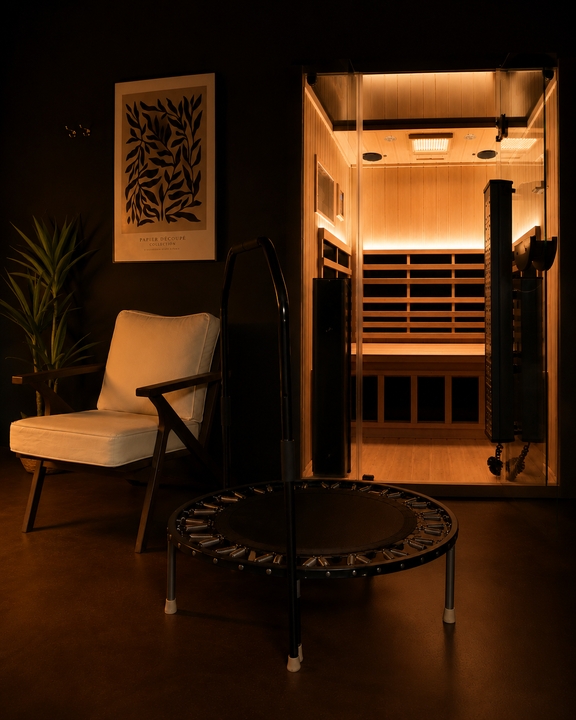
The infrared sauna grew out of a very old human habit: resting in heat. Finland's sauna culture is treasured enough that UNESCO recognized it in 2020. In the 1890s, John Harvey Kellogg built a bulb-warmed "electric light bath." Later, Japanese inventors developed ceramic elements that give off far infrared heat, the warmth inside today's private suites.
You don't need to know the history of a sauna to enjoy one. You can simply sit down, breathe, and let the warmth settle in.
But if you've ever wondered how a quiet private suite in La Porte connects to a Finnish lakeside, a world's fair in Chicago, and a ceramics patent from Japan, this one's for you. It's a story about people, across a very long time, making room to rest in warmth.
How long have people been resting in heat?
A long time. Researchers who reviewed the science of sauna bathing note that it has been practiced in various forms "for thousands of years in many parts of the world." No one can put an exact date on it, and we won't pretend to.
Finland is where the practice became a way of life. In 2020, UNESCO added sauna culture in Finland to its list of the world's intangible cultural heritage. UNESCO describes a tradition handed down through families and communities, centered on löyly, the soft burst of steam that rises when water meets hot stones. "Traditionally," UNESCO writes, "the sauna has been considered as a sacred space – a 'church of nature.'" And it notes that "saunas come in many forms – electric, wood-heated, smoke and infra-red."
We love that infrared has a place in that picture. The heat source matters less than the habit: setting time aside, slowing down, and letting warmth be warmth.
What did the Chicago World's Fair have to do with it?
Here's a detail close to home for Chicagoland. In 1891, Dr. John Harvey Kellogg of Battle Creek, Michigan, built what he called an electric light bath, a cabinet fitted with incandescent bulbs that warmed the person sitting inside. It was put on display at the 1893 World's Fair in Chicago.

Kellogg patented the design in 1896 as a "Radiant-Heat Bath." One line in that patent still describes the basic idea behind infrared saunas today: its warming action "does not depend upon the heat which is transmitted directly by the air." In other words, the bulbs warmed the person directly rather than heating the room until the air itself was hot.
The idea traveled. Within a few years it had crossed the Atlantic, and "Kellogg light baths" were being built in Germany. Kellogg later wrote, with some pride, that European royalty had installed his baths in their palaces.
To be fair to history: many of Kellogg's ideas about what light and heat could do for people didn't hold up. London's Science Museum Group describes his theories as having "proved fanciful," and we aren't repeating them here. What lasted was the simpler part, warming the body directly.
Where does "far infrared" come into the story?
Kellogg's bulbs gave off plenty of visible light along with their warmth. The next chapter came decades later, with materials designed to give off long-wave infrared heat.
In the late 1960s, a Japanese inventor, Tadashi Ishikawa, patented zirconia ceramics designed to radiate long-wave infrared for heating, cooking, and drying. His U.S. patent was granted in 1971. You'll find popular stories online about exactly who built the first infrared sauna and when. We couldn't confirm them from reliable sources, so we're leaving them out.
Over recent decades, infrared sauna cabins have become a popular choice for homes, gyms, and studios like ours. What Studio 7:14 offers is a wellness session: private, quiet time in gentle heat. It is not a medical treatment and isn't a stand-in for one.
What does "far infrared" actually mean?
Infrared is part of ordinary sunlight. You can't see it, but you can feel it as heat. It's the warmth on your face when you step out of the shade.
Scientists sort infrared into bands by wavelength. "Far" infrared simply means the longer wavelengths, sitting farther from the red light our eyes can see. It doesn't mean "deeper" or "stronger." Even the experts draw the lines differently. One international standard (ISO 20473) puts far infrared at 50 to 1,000 micrometers. The International Commission on Non-Ionizing Radiation Protection uses a broader band starting at 3 micrometers, and it names infrared saunas among the everyday sources of infrared.
The difference you'll actually notice is the air. Because an infrared sauna warms you largely through radiant heat, the air doesn't need to be as hot. A 2018 systematic review notes that infrared saunas generally run around 113–140°F (45–60°C), while traditional Finnish saunas run around 176–212°F (80–100°C).
From a world's fair to a quiet room in La Porte
Here's where the story lands: 714 Lincoln Way in La Porte, Indiana.

Your Private Far Infrared Sauna Suite at Studio 7:14 gives you the sauna, a recovery chair, fresh towels, and a rebounder, all to yourself. A red light add-on is available if you'd like it. There's no crowd and no one to keep pace with. It's just warmth, quiet, and room to breathe.
We think the old Finnish instinct had it right. Rest isn't a prize you earn once everything else is done. It's part of caring for the life you've been given.
If you're curious what a first visit is like, start with Your First Infrared Sauna Session. For the plain-language science, read How Does a Far Infrared Sauna Work?. You can learn more on our Far Infrared Sauna page, or reach out to book. You don't need to know anything else before you begin.
Before your session: a quick safety check
A sauna feels gentle, but it is still heat, and heat asks real work of your body. Talk with your doctor before your session if you:
are pregnant or trying to become pregnant
have a heart condition, or blood pressure that runs high or low
take medication that can change how your body handles heat, such as diuretics, beta-blockers, or some antidepressants
are managing any other ongoing health condition
On every visit, drink water before and after, skip alcohol, and skip your session if you feel feverish or unwell. Step out right away if you feel dizzy, lightheaded, or sick to your stomach.
Frequently asked questions
When was the infrared sauna invented?
There's no single invention date. John Harvey Kellogg built an "electric light bath" warmed by incandescent bulbs in 1891, showed it at the 1893 Chicago World's Fair, and patented it as a "Radiant-Heat Bath" in 1896. In the late 1960s, a Japanese inventor patented ceramic elements that radiate long-wave infrared, and infrared sauna cabins have grown steadily more popular in recent decades.
What does "far infrared" mean?
Far infrared refers to the longer wavelengths of infrared, the invisible part of sunlight you feel as warmth. "Far" describes where it sits on the spectrum, farther from the red light we can see. It doesn't mean deeper or stronger. Scientific bodies draw the band's edges a little differently, but in a sauna, all of it is experienced as radiant heat.
How is an infrared sauna different from a traditional Finnish sauna?
A traditional Finnish sauna heats the air, usually to around 176–212°F, often with steam from water poured on hot stones. An infrared sauna warms you largely through radiant heat, so the air typically stays around 113–140°F. Both are heat; they simply deliver it differently. How intense any session feels depends mostly on the temperature and how long you stay.
Is the sauna at Studio 7:14 a medical treatment?
No. Studio 7:14 is a wellness studio, not a medical facility. A sauna session here is private, quiet time in gentle heat for relaxation and rest. It isn't meant to diagnose, treat, or cure anything, and it doesn't replace care from your doctor. If you're managing a health condition, talk with your physician before your first session.
This article is for general education and wellness information only. It is not medical advice and is not intended to diagnose, treat, cure, or prevent any disease. Studio 7:14 is not a medical facility. Talk with your physician before starting any new wellness practice, especially if you are pregnant or nursing, managing a health condition, have an implanted device, or take prescription medication.
